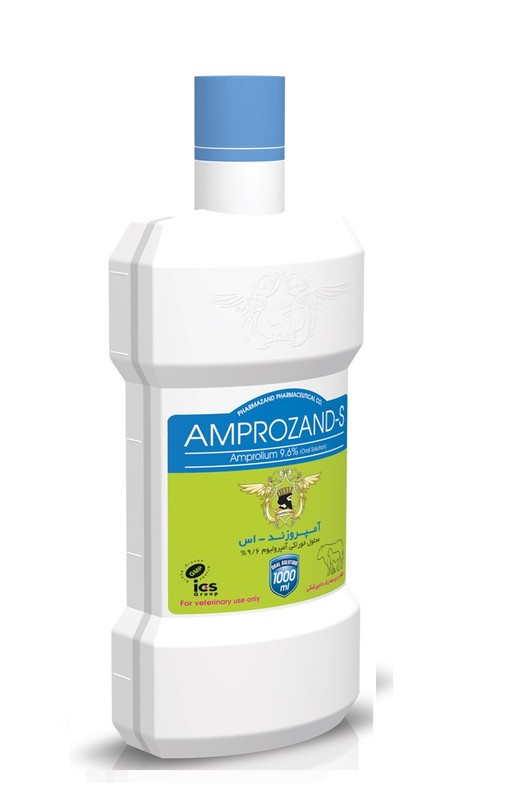
 Anticoccidial solution
Amprozand S®
Amprolium hydrochloride 9.6% Oral Solution
Composition
| Ingredient | Amount | Unit |
|---|---|---|
| Each ml of Amprozand S® contains : | ||
| amprolium hydrochloride | 96 | mg |
Mechanism of action
Amprolium is a quaternized derivative of pyrimidine and a structural analogue of thiamine (vitamin B1), acting as a competitive antagonist of thiamine. By binding to the thiamine transport system in the parasite, it inhibits the uptake and utilization of thiamine, thereby disrupting carbohydrate metabolism and energy production in the parasite. Although a similar effect occurs in host cells, its intensity is significantly lower.
Amprolium is primarily effective during the early stages of the Eimeria life cycle (particularly the first three days) and exerts its highest activity against first-generation trophozoites and schizonts located within enterocytes. By preventing the differentiation of merozoites, it halts the asexual reproduction of the parasite. In addition, it can inhibit sexual stages (gametogony) and reduce oocyst sporulation.
In poultry, amprolium exhibits high activity against Eimeria tenella and Eimeria acervulina. Its activity against Eimeria maxima, Eimeria necatrix, Eimeria brunetti, and Eimeria mivati is weaker. For this reason, it is frequently combined with ethopabate to broaden its spectrum of activity.
Target species
Poultry and turkeys
Indications
Amprozand S® is indicated for the prevention and treatment of coccidiosis caused by susceptible Eimeria species in broiler, replacement pullets, and turkeys. In poultry, it is mainly active against Eimeria tenella and Eimeria acervulina, and has limited activity against Eimeria maxima, Eimeria brunetti, Eimeria mitis, Eimeria praecox, and Eimeria necatrix. In turkeys, Amprozand S® is effective against Eimeria adenoeides, Eimeria meleagrimitis and Eimeria gallopavonis.
Packaging
1 L polyethylene bottles
Storage Conditions
Store below 25°C, protected from direct light, in the original packaging. After opening, keep the container cap tightly closed. Protect from freezing.
Dosage and Administration
1 liter of Amprozand S® per 800 liters of drinking water for 3 to 5 consecutive days.
In cases of severe disease outbreaks: 1 liter of Amprozand S® per 400 liters of drinking water for 3 to 5 consecutive days, followed by continuation of treatment at a rate of 1 liter of Amprozand S® per 1600 liters of drinking water for 1 to 2 weeks.
- As directed by a veterinarian.
In cases of severe disease outbreaks: 1 liter of Amprozand S® per 400 liters of drinking water for 3 to 5 consecutive days, followed by continuation of treatment at a rate of 1 liter of Amprozand S® per 1600 liters of drinking water for 1 to 2 weeks.
- As directed by a veterinarian.
Withdrawal period
Meat and offal: 3 days
Contraindications
Do not use in laying hens producing eggs for human consumption.
Precautions
Prolonged administration of Amprozand S® at doses higher than recommended may cause growth retardation or polyneuritis, and may also delay the development of the immune system.
Medicated drinking water should be used within 24 hours.
Keep out of the reach and sight of children.
Medicated drinking water should be used within 24 hours.
Keep out of the reach and sight of children.
Drug interactions
Concomitant use of Amprozand S® with dietary supplements containing vitamin B1 (thiamine) must be avoided, as it decreases the efficacy of amprolium.
Amprolium hydrochloride 9.6% Oral Solution