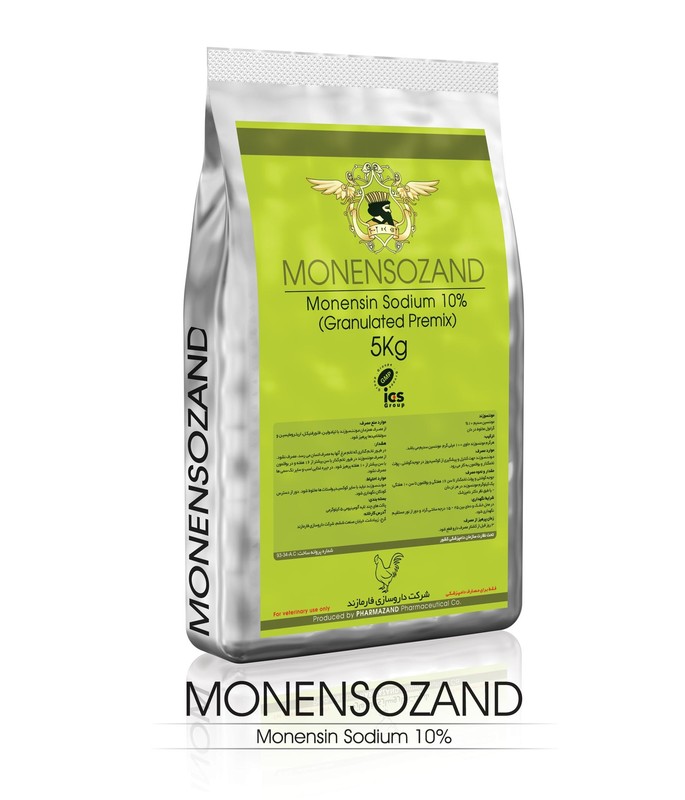
 Anticoccidial powder
MonensoZand®
Monensin Sodium 10% Granulated Premix
Composition
| Ingredient | Amount | Unit |
|---|---|---|
| Each gram of MonensoZand® contains | ||
| monensin sodium | 100 | mg |
Mechanism of action
Monensin is a polyether monocarboxylic ionophore obtained from the fermentation of Streptomyces cinnamonensis. Monensin forms complexes with monovalent cations, particularly sodium (Na⁺) and potassium (K⁺), facilitating the transport of these ions across biological membranes. The lipid-soluble monensin–cation complex crosses the membrane, altering ion transport and disrupting ionic gradients and the electrochemical balance of the cell. As a result, the parasite’s ionic and osmotic homeostasis is disturbed, leading to impairment of vital cellular and metabolic processes, ultimately causing damage and death of sensitive stages of Eimeria.
In poultry, monensin acts on both extracellular and intracellular stages of the Eimeria life cycle, particularly the early asexual stages. The ionophoric activity of monensin causes damage to sporozoites and other susceptible stages of the parasite, preventing successful invasion and development within host cells. Consequently, Eimeria development and the severity of infection are reduced, and the occurrence of coccidiosis is prevented.
Monensin also improves feed efficiency in ruminants by modifying the rumen microbial population and fermentation patterns. This effect is predominantly associated with alterations in rumen microbial metabolism and a relative increase in propionate production.
Target species
Broilers and layer Pullets, turkeys, dairy cows, beef cattle, calves and goats
Indications
Broilers and layer Pullets
For the prevention of coccidiosis caused by susceptible Eimeria species, including Eimeria tenella, Eimeria necatrix, Eimeria acervulina, Eimeria brunetti, Eimeria maxima, and Eimeria mitis.
Turkeys
For the prevention of coccidiosis caused by Eimeria adenoeides, Eimeria meleagrimitis, and Eimeria gallopavonis.
Beef cattle
For improved feed efficiency and increased rate of weight gain; also, for the prevention and control of coccidiosis caused by Eimeria bovis and Eimeria zuernii.
Dairy cows
For improved milk production efficiency and increased milk yield per unit of feed intake.
Calves
For the prevention and control of coccidiosis caused by Eimeria bovis and Eimeria zuernii in calves; excluding veal calves.
Goats maintained in confinement
For the prevention of coccidiosis caused by Eimeria crandallis, Eimeria christenseni, and Eimeria ninakohlyakimovae.
Packaging
5 kg multilayer aluminium sachets
Storage Conditions
Store in a dry place below 25°C, protected from direct light, in the original packaging. Once opened, keep the sachet tightly closed.
Dosage and Administration
Broilers
100 to 125 mg monensin per kg of feed equivalent to 1 to 1.25 kg of MonensoZand® per ton of feed.
Layer Pullets
100 to 120 mg monensin per kg of feed equivalent to 1 to 1.2 kg of MonensoZand® per ton of feed, up to a maximum of 16 weeks of age.
Turkeys
60 to 10 mg monensin per kg of feed equivalent to 600 g to 1 kg of MonensoZand® per ton of feed, up to a maximum of 16 weeks of age.
Beef Cattle
For improved feed efficiency:
Feed continuously at 5 to 40 g monensin per ton of feed on a 90% dry matter basis equivalent to 50 to 400 g of MonensoZand® per ton of feed to provide 50 to 480 mg monensin per head per day.
For prevention and control of coccidiosis:
Feed continuously at 10 to 40 g monensin equivalent to 100 to 400 g of MonensoZand® per ton of feed to provide 0.3 to 0.9 mg monensin per kg body weight per day (up to a maximum of 480 mg per head per day, depending on the severity of challenge).
Dairy Cows
For improved milk production efficiency, including increased solid-corrected milk yield per unit of feed intake:
Total Mixed Ration (TMR): Feed continuously to dry and lactating dairy cows in a total mixed ration containing 11 to 22 g monensin equivalent to 110 to 220 g of MonensoZand® per ton of feed on a 100% dry matter basis.
Calves:
Administer 0.3 to 2.2 mg monensin equivalent to 3 to 22 mg of MonensoZand® per kg body weight per day, depending on the severity of challenge; ensure total daily intake does not exceed 200 mg monensin equivalent to 2 g of MonensoZand® per head per day.
Goats
Feed continuously at 20 mg monensin sodium per kg of feed equivalent to 200 g of MonensoZand® per ton of feed.
- As directed by a veterinarian.
Withdrawal period
Meat and offal: 3 days
Layer pullets and turkeys: Do not use beyond 16 weeks of age.
Layer pullets and turkeys: Do not use beyond 16 weeks of age.
Contraindications
Do not use in laying hens producing eggs for human consumption.
Do not use in reproducing and lactating goats.
Administration of MonensoZand® to horses and other equines is fatal.
Do not use in reproducing and lactating goats.
Administration of MonensoZand® to horses and other equines is fatal.
Precautions
When handling MonensoZand®, wear gloves, protective eyewear, and appropriate respiratory protective equipment.
Avoid inhalation of MonensoZand® dust and prevent contact with eyes and skin.
Keep out of the reach of children.
Avoid inhalation of MonensoZand® dust and prevent contact with eyes and skin.
Keep out of the reach of children.
Drug interactions
Concomitant use of MonensoZand® with erythromycin and certain sulfonamides (such as sulfaquinoxaline) is not recommended due to the potential risk of increased salinomycin toxicity.
Concomitant use of MonensoZand® with florfenicol may decrease plasma concentrations of florfenicol and reduce its efficacy.
MonensoZand® should not be used concomitantly with other other ionophore coccidiostats.
Concomitant use of MonensoZand® with florfenicol may decrease plasma concentrations of florfenicol and reduce its efficacy.
MonensoZand® should not be used concomitantly with other other ionophore coccidiostats.
Monensin Sodium 10% Granulated Premix