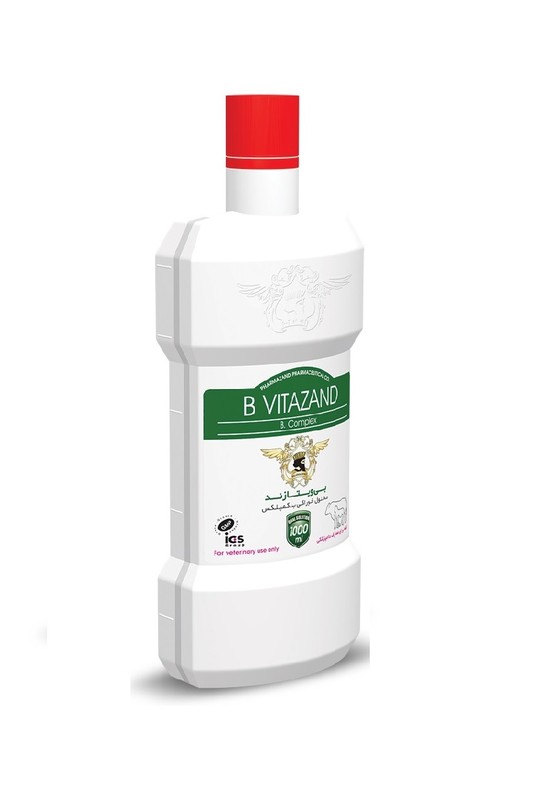
 Vitamin solution
B Vitazand®
B-Complex Oral Solution
Composition
| Ingredient | Amount | Unit |
|---|---|---|
| Each ml of B Vitazand® contains: | ||
| Vitamin B1 (Thiamine hydrochloride) | 10 | mg |
| Vitamin B2 (Riboflavin-5-phosphate sodium) | 1.5 | mg |
| Vitamin B3 (Niacinamide) | 25 | mg |
| Vitamin B5 (Dexpanthenol) | 5 | mg |
| Vitamin B6 (Pyridoxine hydrochloride) | 4 | mg |
Mechanism of action
B-complex vitamins are water-soluble essential micronutrients that function as coenzymes or coenzyme precursors in a wide range of enzymatic pathways. They play fundamental roles in carbohydrate, lipid, and protein metabolism; cellular energy production (ATP synthesis); tissue maintenance; and the regulation of nervous, immune, and reproductive functions:
• Vitamin B1 (thiamine): After conversion to its active coenzyme form, thiamine pyrophosphate (TPP), it acts as an essential cofactor for key enzyme complexes involved in carbohydrate catabolism, including pyruvate dehydrogenase and alpha-ketoglutarate dehydrogenase, as well as transketolase in the pentose phosphate pathway. It is vital for cellular energy metabolism and normal central and peripheral nervous system function.
• Vitamin B2 (riboflavin): Serves as a precursor of the flavin coenzymes flavin mononucleotide (FMN) and flavin adenine dinucleotide (FAD). These coenzymes participate in cellular respiration, the electron transport chain, fatty acid beta-oxidation, and the conversion of pyridoxine and folic acid to their active metabolites.
• Vitamin B3 (niacinamide): Is a functional component of the nicotinamide adenine dinucleotide coenzymes (NAD/NADH and NADP/NADPH). These cofactors drive numerous cellular oxidation-reduction reactions, oxidative phosphorylation, glycolysis, and lipid synthesis, supporting tissue integrity and metabolic homeostasis.
• Vitamin B5 (dexpanthenol): Is converted to pantothenic acid, an essential component of coenzyme A (CoA) and acyl carrier protein (ACP). It is required for the tricarboxylic acid (Krebs) cycle, acyl-group transfer, fatty acid synthesis and degradation, gluconeogenesis, and the biosynthesis of steroid hormones and acetylcholine.
• Vitamin B6 (pyridoxine): Is converted in vivo to pyridoxal 5′-phosphate (PLP), a key coenzyme in nitrogen and amino acid metabolism, including transamination, decarboxylation, racemization, and the metabolism of sulfur-containing amino acids. It also participates in glycogenolysis, heme biosynthesis, and immune function.
Target species
Poultry
Indications
B Vitazand® is indicated for use in poultry for:
• Prevention and treatment of B-complex vitamin deficiencies and associated conditions, including polyneuritis, curled-toe paralysis, poor feathering, perosis, weakness, anorexia, and impaired growth.
• Support of growth, performance, and productivity, including optimal growth, flock uniformity, and feed conversion efficiency (FCR), particularly during periods of increased metabolic demand or inadequate dietary vitamin intake.
• Support of reproductive performance in breeding and laying flocks, including maintenance of egg production, eggshell quality, fertility, and hatchability.
• Support during periods of stress associated with management and environmental challenges, including vaccination, medication, beak trimming, regrouping, transport, convalescence following infectious diseases, and heat stress.
• Supportive nutritional therapy in metabolic disorders, particularly fatty liver hemorrhagic syndrome (FLHS) and impaired hepatic lipid metabolism.
Packaging
1 liter polyethylene bottles
Storage Conditions
Store below 25 °C, away from direct sunlight, and in the original container. Close the container cap tightly after opening. Protect from freezing.
Dosage and Administration
1 liter of B Vitazand® per 1000 to 2000 liters of drinking water for 5 to 7 consecutive days.
- As directed by veterinarian
- As directed by veterinarian
Withdrawal period
Meat and offal: 0 days
Eggs: 0 days
Eggs: 0 days
Contraindications
No adverse effects have been reported at the recommended dosage.
Precautions
Avoid prolonged administration of B Vitazand® or concomitant use with other products containing similar ingredients, except under the direction of a veterinarian.
Medicated drinking water should be used within 24 hours.
Keep out of reach of children.
Medicated drinking water should be used within 24 hours.
Keep out of reach of children.
Drug interactions
No known drug interactions have been reported at the recommended dosage.
B-Complex Oral Solution